by Nafije K. Prishtina, Florence W. Williams
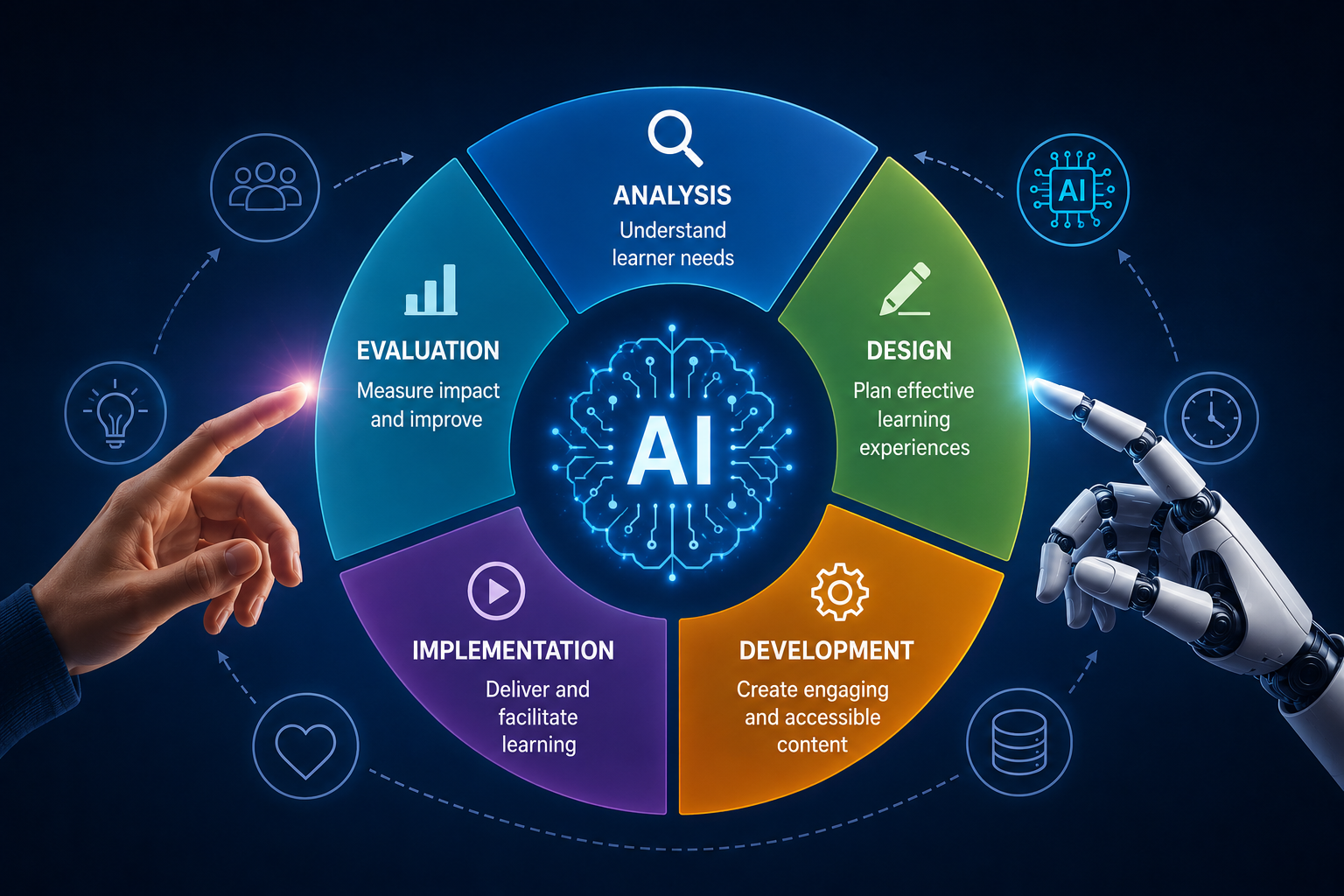
Across the ADDIE framework, AI supports ideation, drafting, summarization, and pattern recognition, while instructional designers remain responsible for pedagogical alignment, accessibility, ethical review, and learner-centered decision-making.
Abstract
The increasing use of generative artificial intelligence (AI) in higher education is prompting a rethinking of instructional design practices. This paper explores how AI tools can be integrated into the ADDIE framework to support course development, particularly in non-academic and professional learning environments. Drawing on practice-based work, the paper highlights where AI adds the most value—especially in ideation and content development—while emphasizing the continued importance of human expertise for interpretation, ethical decision-making, and pedagogical alignment. The discussion positions AI not as a replacement for instructional designers, but as a collaborative partner that can extend and enhance existing design processes when used intentionally.
Introduction
Generative artificial intelligence is quickly becoming part of everyday instructional design work. Tools that can generate course content, assessments, and feedback are reshaping how designers and faculty approach course development. While these tools offer clear efficiencies, they also introduce important questions about quality, ethics, and alignment with sound pedagogical practice (Ch’ng, 2023; Mangtani, 2024). While these tools offer clear efficiencies, they also introduce important questions about quality, ethics, and alignment with sound pedagogical practice. Williams and Prishtina (2026) note in their practice-based reflection on AI and instructional design, that meaningful learning still depends on critique, revision, and pedagogical judgment rather than superficial output generation. This reinforces the need to approach AI as a collaborative design partner rather than a substitute for instructional expertise.
Much of the current conversation around AI in education focuses on what these tools can produce, but far less attention is given to how they should be used within established instructional frameworks. Without that structure, AI risks driving decisions that should remain grounded in pedagogy. Instructional design, as emphasized by Reiser et al. (2024), is fundamentally about intentional alignment between objectives, activities, and assessments—not simply content production.
This paper argues that the ADDIE framework provides a stable and familiar structure for integrating AI into instructional design. Rather than replacing established processes, AI can be embedded within each phase of ADDIE to support efficiency while preserving the central role of human expertise. Efficiency matters because it frees designers to spend more time on alignment, accessibility, learner support, and revision. In this sense, AI is best understood as a tool that extends faculty and designer capabilities (Davenport & Kirby, 2016; Luckin et al., 2016).
Situating AI Within Instructional Design Practice
The ADDIE model continues to be widely used because of its balance between structure and flexibility (Branch, 2009; Reiser et al. 2024). Although often described as linear, it is more accurately applied as an iterative framework that adapts to different design contexts. This adaptability makes it particularly useful for integrating emerging technologies such as AI.
AI has demonstrated value in several areas of instructional design, including content generation, assessment development, and data analysis (Ch’ng, 2023). At the same time, the literature highlights important concerns related to bias, data privacy, and the risk of diminishing instructional quality when AI is used without sufficient oversight (Mangtani, 2024). These concerns reinforce the need to approach AI integration thoughtfully rather than opportunistically.
Learning theory further underscores this point. Cognitive Load Theory reminds us that instructional materials must be carefully structured to avoid overwhelming learners (Sweller et al., 2011). AI-generated content, while efficient, can increase extraneous cognitive load if not curated carefully. Similarly, Universal Design for Learning emphasizes the importance of designing accessibility and learner variability from the outset (CAST, 2018). AI can support these goals, but only when its outputs are intentionally aligned with inclusive design principles.
The concept of Human–AI collaboration offers a useful way to think about this integration. Cavalier (2025) describes a “Human plus AI plus Human” model in which AI generates initial outputs, and human designers refine and contextualize them. This approach reflects broader work on augmented intelligence, which emphasizes the complementary strengths of humans and machines (Davenport & Kirby, 2016).
Context of Practice
This work is grounded in instructional design practice at the University of Central Florida’s Center for Distributed Learning. Within this context, AI tools were explored as part of course development for non-academic and professional learning environments delivered through Webcourses@UCF.
As interest in AI grew among faculty and staff, instructional designers were increasingly asked to provide guidance on how these tools could be used effectively. Rather than treating AI as a separate or experimental addition, the goal was to understand how it could be integrated into existing workflows. The ADDIE framework provided a natural structure for this exploration, allowing designers to examine AI use across the full design process rather than in isolated tasks.
Integrating AI Across the ADDIE Framework
When viewed through the ADDIE framework, AI supports different types of work at each stage of the design process. Table 1 provides a concise preview of how AI-supported activities are operationalized within the instructional design workflow.
Table 1
AI Integration Within the ADDIE Framework
| ADDIE Phase | AI-Supported Activities | Human Designer Role | Key Risks to Monitor |
|---|---|---|---|
| Analysis | Validate findings, interpret learner needs, and ensure contextual relevance | Validate findings, interpret learner needs, ensure contextual relevance | Bias, misrepresentation of learner needs |
| Design | Drafting learning objectives, suggesting activities, alignment checks | Ensure pedagogical alignment, meaningful outcomes, instructional coherence | Superficial alignment, weak instructional depth |
| Development | Generating assessments, rubrics, content drafts, resource suggestions | Revise for accuracy, accessibility, clarity, and cognitive load management | Inaccurate content, cognitive overload, accessibility gaps |
| Implementation | Automated feedback, learner messaging, communication support | Monitor clarity, appropriateness, and learner engagement | Impersonal communication, over-automation |
| Evaluation | Identifying performance trends, summarizing learner feedback | Interpret results, recommend instructional improvements | Misinterpretation of analytics, overreliance on AI output |
During the analysis phase, AI tools were particularly helpful for summarizing survey data, identifying patterns, and generating initial learner personas. These capabilities made it easier to process large amounts of information efficiently. However, designers still needed to validate findings and interpret them within the specific instructional context, especially given concerns about bias and misrepresentation (Davenport & Kirby, 2016).
In the design phase, AI functioned as a useful ideation partner. It could generate draft learning objectives, suggest activities, and support alignment checks. While this accelerated early-stage work, designers remained responsible for ensuring that outputs reflected pedagogical intent and meaningful learning outcomes Reiser et al. (2024).
The development phase revealed both the strengths and limitations of AI. Tools could generate assessments, rubrics, and instructional content, reducing time spent on repetitive tasks. At the same time, these outputs often require revision for accuracy, clarity, and accessibility. From a Cognitive Load Theory perspective, poorly structured materials risk increasing unnecessary cognitive demand on learners (Sweller et al., 2011), while UDL principles require that content remain accessible and flexible (CAST, 2018).
During implementation, AI supported communication and learner engagement through automated feedback and messaging tools. These tools improved scalability but required monitoring to ensure that communication remained clear and appropriate.
In the evaluation phase, AI assisted with identifying trends in learner performance and summarizing feedback data. While this supported data-driven decision-making, designers remained responsible for interpreting results and determining instructional improvements.
Across all phases, a consistent pattern emerged: AI was most effective when used to generate or support initial work, while human designers provided interpretation, refinement, and alignment.
What Is Working Well
One of the most immediate benefits of AI integration was increased efficiency. Tasks such as drafting content or summarizing data could be completed more quickly, allowing designers to focus on higher-level decisions related to learning design and learner experience (Ch’ng, 2023).
AI also supported creativity by offering multiple starting points for design work. Rather than beginning from scratch, designers could iterate on generated ideas, which expanded possibilities and supported more flexible thinking. This aligns with Cavalier’s (2025) view of AI as a tool for enhancing, rather than replacing, professional expertise.
In addition, AI contributed to scalability. In professional learning environments where timelines are often compressed, the ability to generate content quickly allows for more efficient development without necessarily sacrificing quality—if outputs were carefully reviewed.
Ongoing Challenges
Despite these benefits, several challenges remain. One of the most consistent issues was the reliability of AI-generated content. Outputs often require revision for accuracy, tone, and contextual relevance. In some cases, content appeared polished but lacked depth or precision, which could negatively affect instructional quality. This reinforces the importance of instructional designers reviewing AI-generated outputs for accuracy, contextual relevance, and alignment with meaningful learning outcomes.
Bias is another concern. AI systems reflect the data on which they are trained, which means they can reproduce existing inequities if not critically evaluated (Mangtani, 2024). This places responsibility for instructional designers to review outputs carefully and ensure that materials are inclusive and appropriate.
There is also the issue of cognitive overload. While AI can generate large amounts of content quickly, more content does not necessarily lead to better learning. Without careful design, learners may become overwhelmed, which undermines comprehension (Sweller et al., 2011).
Finally, there is a risk of over-reliance on AI. Instructional design requires judgment, context awareness, and ethical decision-making—areas where human expertise remains essential (Davenport & Kirby, 2016).
Human–AI Collaboration in Practice
The most effective approach observed in this work aligns with a Human–AI–Human model. In this workflow, AI is used to generate ideas or draft materials, and human designers then refine and adapt those outputs based on instructional goals and learner needs (Cavalier, 2025).
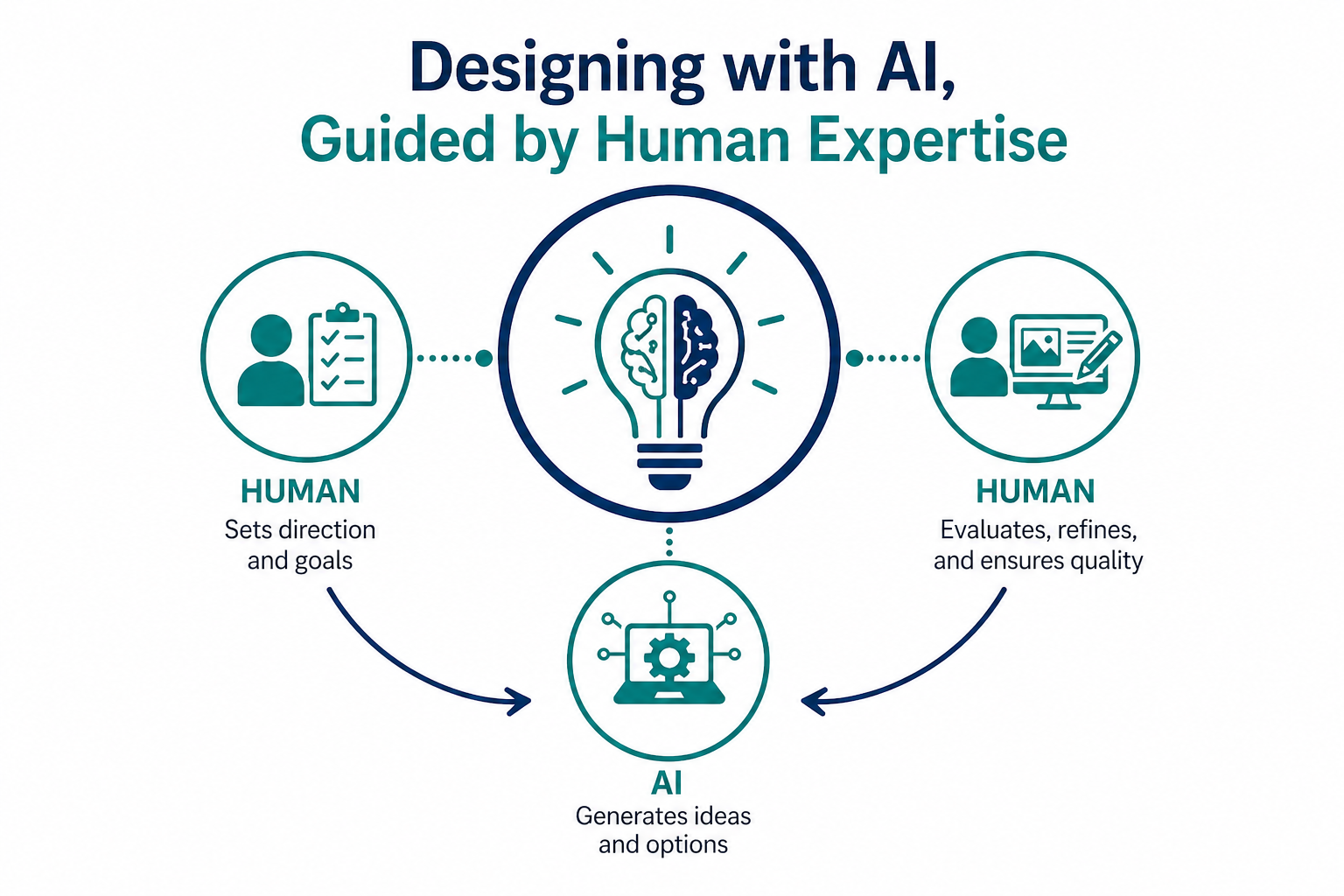
This approach ensures that AI enhances efficiency without displacing the expertise required for effective instructional design. As Luckin et al. (2016) argue, AI should be understood as a tool that extends human capability rather than replaces it. Within the ADDIE framework, this means that designers remain central to decision-making at every stage.
Implications for Practice
Several key considerations emerge for practitioners integrating AI into instructional design. First, design should remain grounded in pedagogy. AI should support learning objectives, not define them (Branch, 2009). Second, AI-generated outputs must be critically evaluated to ensure quality, accuracy, and alignment with instructional goals (Mangtani, 2024). Third, transparency in AI use helps build trust and supports responsible implementation. Finally, all decisions should remain focused on improving learner outcomes, ensuring that efficiency gains do not come at the expense of meaningful learning experiences (CAST, 2018).
Conclusion
AI presents meaningful opportunities for enhancing instructional design, but its effectiveness depends on how it is integrated into existing practices. The ADDIE framework provides a structured and reliable approach for incorporating AI while maintaining pedagogical integrity. This paper shows that AI is most valuable when used as a collaborative partner that supports ideation, development, and analysis, while human designers remain responsible for interpretation, alignment, and ethical decision-making.
Importantly, the Human–AI–Human approach does not directly automate learning but instead strengthens the conditions under which learning occurs. By reducing extraneous cognitive load, increasing accessibility, and improving the efficiency and quality of instructional design processes, AI-supported workflows enable more intentional, inclusive, and learner-centered experiences. These improvements align with established learning theories, suggesting that AI contributes to learning outcomes indirectly—through the enhancement of design, delivery, and engagement—rather than through direct instructional substitution.
Moving forward, the focus should not be on replacing instructional design practices, but on strengthening them through thoughtful and intentional use of AI. When guided by pedagogical purpose and human expertise, AI has the potential to extend instructional design in ways that are both scalable and meaningful, ensuring that innovation remains aligned with the core goal of improving learning.
References
Branch, R. M. (2009). Instructional design: The ADDIE approach. Springer. https://doi.org/10.1007/978-0-387-09506-6
CAST. (2018). Universal Design for Learning guidelines version 2.2. https://udlguidelines.cast.org/
Cavalier, J. (2025). Applying AI in learning and development: From platforms to performance. Association for Talent Development. https://books.google.com/books/about/Applying_AI_in_Learning_and_Development.html?id=wPKs0AEACAAJ
Ch’ng, L. K. (2023). How AI makes its mark on instructional design. Asian Journal of Distance Education, 18(2). https://doi.org/10.5281/zenodo.8188576
Davenport, T. H., & Kirby, J. (2016). Only humans need apply: Winners and losers in the age of smart machines. Harper Business. https://www.harpercollins.com/products/only-humans-need-apply-thomas-h-davenportjulia-kirby
Luckin, R., Holmes, W., Griffiths, M., & Forcier, L. B. (2016). Intelligence unleashed: An argument for AI in education. Pearson. https://books.google.com/books/about/Intelligence_Unleashed.html?id=3OZduwEACAAJ
Mangtani, A.J. (2024). AI in Instructional Design: Foundation, Innovations, and Ethical Considerations. In: Instructional Design Unleashed. Design Thinking. Apress, Berkeley, CA. https://doi.org/10.1007/979-8-8688-0416-8_11
Reiser, R. A., Carr-Chellman, A. A., & Dempsey, J. V. (Eds.). (2024). Trends and issues in instructional design and technology (5th ed.). Routledge. https://doi.org/10.4324/9781003502302
Sweller, J., Ayres, P., & Kalyuga, S. (2011). Cognitive load theory. Springer. https://doi.org/10.1007/978-1-4419-8126-4
University of Central Florida, Center for Distributed Learning. (2022). Special Programs course model. https://webcourses.ucf.edu/courses/1429729
Williams, F., & Prishtina, N. (2026). Coding the Curriculum: A Critique of “How AI Makes its Mark on Instructional Design”. Journal of Teaching and Learning with Technology, 12(1). https://scholarworks.iu.edu/journals/index.php/jotlt/article/view/41129
Author
Nafije K. Prishtina, Instructional Technology Specialist, Center for Distributed Learning, University of Central Florida
Florence W. Williams, Senior Instructional Designer, Center for Distributed Learning, University of Central Florida