Embracing Change: A Journey Through Transition (Issue 41)

Two diverging forest paths

Author: Dr. Denise Lowe, University of Central Florida, (retired 4/30/2026)

Editors: Dr. Florence Williams and Bren Bedford, University of Central Florida

Dear Readers,

For this article, ADDIE is taking a different approach – one that speaks directly to the supporters, users, and contributors to TOPkit.org / Ask ADDIE as we contemplate a potential shift in direction for both.

Imagine you’re standing at a crossroads, with one path leading to the familiar comforts of your current job responsibilities and the other veering into the unknown, filled with potential risks and rewards. As you gaze down each path, a question lingers in your mind: “What if I take the leap into the unknown and embrace change—will it lead to a new beginning or a daunting setback?”

It has been said that “Change is the only constant in life.” This timeless quote by Heraclitus resonates deeply as we navigate the unpredictable currents of our organizational lives. Whether it’s a new project, a restructuring initiative, or a shift in funding, change can feel overwhelming. Yet, understanding how to transition through these changes is essential for personal and professional growth. As we explore the nature of change and transition, we can learn to embrace these shifts leading to new opportunities and profound transformation.

TOPkit.org was originally designed and developed as a grant-funded, statewide faculty development program. The resources included Ask ADDIE – contributory articles designed to be a voice for instructional designers and faculty instructors to learn from one another as they navigated the world of online and hybrid higher education challenges and opportunities.

While primarily maintained by the University of Central Florida (UCF), TOPkit.org was always a shared program with State of Florida university partners – the grant is up for renewal and its future is uncertain. If the grant is renewed, other state partners may continue its design, development, and maintenance. Additionally, Ask ADDIE may be discontinued completely – this may be the last article written for Ask ADDIE. The latter is unexpected news – these resources may no longer exist in their current form. The program roles and responsibilities are changing, and we are in a potential transition from work that UCF has invested in for several years.
Embracing change can lead to unexpected paths and rewarding outcomes.

Change is not just an external event; it encompasses both the circumstances we face and the internal transitions we undergo. While change is the tangible shift in our environment, transition is the psychological process (Flovik, Knardahl, & Christensen, 2019) that follows. The initial reaction may be confusion or a sense of loss – common responses when faced with institutional changes.

As we grapple with potential new realities, we may experience conflicting emotions: Relief (due to workload challenges); sadness (a true enjoyment of the roles); a sense of loss (due to investment of time & energy); and eventually, a flicker of hope (contemplation of a new season). This emotional rollercoaster is a hallmark of transition. Psychologists often describe these stages as a journey through grief and acceptance, akin to the stages of mourning – yes, even for role responsibilities through one’s work!

At first, we may find ourselves replaying our professional investment in this program over and over. “We’ve done so much good work! Do we really want to let go of this role?”, we ask ourselves. Gradually, acceptance comes as we realize that while we cannot control institutional change, we can control our response to it. This realization is crucial; understanding that emotional turmoil is a natural part of transitioning helps individuals navigate their feelings with compassion.

Reflecting on similar work situations, there are a number of strategies for navigating institutional and personal change successfully (Horlick, 2026). Some of these are provided below:

Transparent Communication Emphasize the importance of open dialogue. By keeping everyone informed about the reasons for the change and the plans moving forward, the institution can reduce uncertainty and build trust.
Explore New OpportunitiesRecognize the need for new allocations of your time and effort by brainstorming alternative approaches or new role opportunities. This proactive approach fosters a sense of agency among members.
Support and TrainingImplement workshops to help staff develop skills in new professional areas allows employees to feel empowered and equipped to tackle the challenges ahead. Since transitions also have psychological and emotional impacts, reaching out to colleagues and mentors provides the support needed for sharing anxieties and aspirations, diminishing the feeling of isolation.
MentorshipSeek the input of a mentor who has faced similar situations in the past. This can be helpful for advice, recommendations, and specific strategic steps for program transitions.
MindfulnessPractice mindfulness to help in staying grounded amidst uncertainty. By focusing on the present moment, we can learn to manage any anxiety about the future.
Goal SettingLearn to set small, achievable goals. This approach transforms potentially overwhelming situations into manageable steps, such as updating the necessary program resources, communicating the changes effectively, and networking with other colleagues. It can also help with visioning and looking forward to new opportunities and directions for your time and efforts.

These strategies empower us to reclaim control over our time and effort, reinforcing the idea that resilience and adaptability are keys to thriving in the face of change. As time passes, we can begin to embrace the new institutional reality. Emerging work interests and passions can evolve as time allows. What initially felt like a setback transforms into an opportunity for growth. Through this journey, we learn that change does not signify the end but rather a new beginning. Many institutions have experienced similar transformations, where embracing change has led to improved performance and renewed mission focus. The success stories of nonprofits that have diversified their resources serve as powerful examples of the positive outcomes that can arise from navigating difficult transitions. Entrepreneurs often cite moments of failure as the catalyst for their most successful ventures. Embracing change can lead to unexpected paths and rewarding outcomes.

Reflecting on our transitional journeys, we can recognize the strength we gain along the way. Sometimes, new seasons are ushered in by changes allowing us to discover new passions. While change can be daunting, it also opens doors to new possibilities. In a world where change is inevitable, it is essential for institutions – and their members – to embrace it rather than resist it (Fifer, 2017).

Change is a powerful teacher and a critical element of growth, inviting us to grow beyond our comfort zones. What transformations await you on the other side of change? Embrace the journey, for it may lead you to places you never imagined.

As for the future of TOPkit.org and/or Ask ADDIE – those decisions have not yet been made, so we wait.

What transitions are you navigating right now that impact instructional design or faculty development? Share your reflections, strategies, or lessons learned with the TOPkit community in the areas of planning, developing, and evaluating.

For now, this is ADDIE – signing off.

References

Ask ADDIE. (2026, April 29). TOPkit – Home – Ask ADDIE. Retrieved April 29, 2026 from https://topkit.org/ask-addie-home/

Bridges, W. (2016). Managing transitions: Making the most of change (4th edition). Da Capo Lifelong Books.

Fifer, J. J. (2017, July 31). The upside of change. hfma (healthcare financial management association). https://www.hfma.org/leadership/55046/

Flovk, L., Knardahl, S., & Christensen, J.O. (2019, December 19). The effect of organizational changes on the psychosocial work environment: Changes in psychological and social working conditions following organizational changes. Frontiers in Psychology, 10:2845 https://doi.org/10.3389/fpsyg.2019.02845

Heraclitus Quotes. (n.d.). BrainyQuote.com. Retrieved April 29, 2026, from BrainyQuote.com Web site: https://www.brainyquote.com/quotes/heraclitus_165537

Horlick, A. (2026, April 29). Understanding organizational change management strategies. Prosci. https://www.prosci.com/blog/what-we-mean-by-organizational-change-management

Kotter, J. P. (2012). Leading change. Harvard Business Review Press.

TOPkit. (2026, April 29). Home – TOPkit. Retrieved April 29, 2026 from https://topkit.org/
Unlocking the Power of Quiz Analytics for Smarter Assessments (Issue 35)

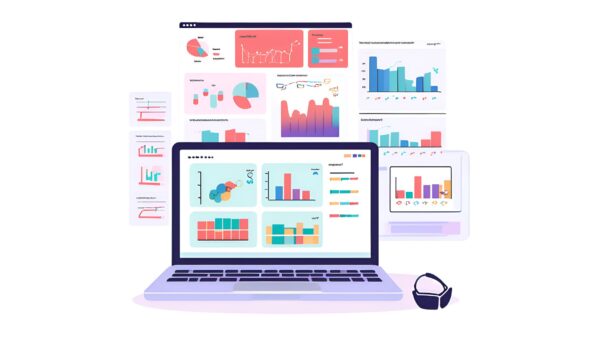
Computer screens displaying various data analytics graphs

Author:Dr. Jo Ann Smith, University of Central Florida 

Editor: Dr. Denise Lowe, University of Central Florida

Dear ADDIE, 

I’ve been using quizzes in my online course to assess student learning, but I’m not sure how to make the most of the data provided by the LMS quiz analytics tools. I want to ensure my quizzes are effective and truly reflective of student understanding. What should I look for in the data, and how can I use this information to improve my quizzes? 

Signed,

Quizzer in Quandary 

The goal of data analytics is to enhance the quality of quiz items and support an overall assessment strategy.

Dear Quizzer, 

What a great and relevant question in today’s data-driven landscape! Learning Management Systems (LMS) like Canvas, Blackboard, and Moodle offer quiz analytics tools based provide you with useful information about student learning and engagement. By understanding the types of analytics available and how to interpret them, you can enhance the effectiveness of your quizzes and ensure assessments are providing you with meaningful information about your students’ learning (Brown & Race, 2012; Deetjen-Ruiz et al. 2023; Kumar, et al 2021; Gamage, et al, 2019). Let’s break down the key types of analytics commonly provided by LMS quiz tools and discuss how you can leverage these insights for quiz improvement. 

Using Quiz Analytics to Refine Assessments 

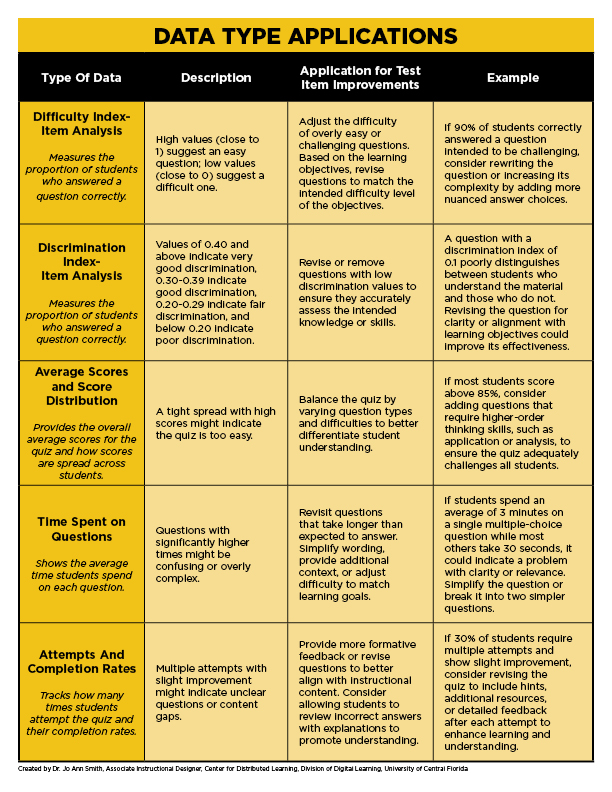
When analyzing quiz data, there are several key statistics that can guide your decision-making and provide valuable insights into student performance and question effectiveness. The goal is to use this data to enhance both the quality of your quiz items and support the overall assessment strategy. Below is a table outlining five common types of analytics provided by LMS quiz tools and how to use these insights to improve your quiz items. Each data type is paired with an example to illustrate how it can inform specific actions for you to take to refine assessments. 

Data Type Applications table with item analysis, description, improvement applications, and examples provided.

By analyzing these types of data, you can refine your quizzes to ensure that each question is clear, fair, and aligned with your student learning objectives. This iterative process of reviewing and revising assessments based on data helps create more effective learning experiences and ensures that quizzes serve as meaningful tools for both learning and evaluation. 

You could also experiment with adaptive tests that adjusts question difficulty based on student performance. Heat map quiz analytics are also a good visual to quickly identify question items where rows represent a question, and each column represents a student. A specific question might show mostly green colors except for a few patches of red, suggesting that while most students answered quickly and correctly, a few took longer and answered incorrectly. This visual clue could prompt a review of that question to determine if it was unclear or too difficult for those students. 

I also like to use data from open-ended responses to understand the depth of student understanding beyond what multiple-choice questions can provide. Additionally, you could explore the impact of quiz timing (e.g., open-book vs. closed-book quizzes) and provide immediate feedback to further enhance student learning and engagement. 

We’d love to hear your thoughts on innovative uses of LMS quiz tools to enhance learning outcomes. What other ideas or plans for the use of data analytics have you applied or are exploring at your higher education institution? Please share your thoughts with our TOPkit community on LinkedIn!

References 

Brown, S., & Race, P. (2012). Using Effective Assessment to Drive Student Learning. Higher Education Academy. 

Deetjen-Ruiz, R., Esponda-Pérez, J. A., Haris, I., García, D. S., Osorio, J. L. Q., & Tsarev, R. (2023). Evaluating the Reliability of Tests Used in LMS Moodle for E-Learning. In Proceedings of the Computational Methods in Systems and Software (pp. 1-8). Cham: Springer Nature Switzerland. 

Kumar, D., Jaipurkar, R., Shekhar, A., Sikri, G., & Srinivas, V. (2021). Item analysis of multiple choice questions: A quality assurance test for an assessment tool. Medical Journal Armed Forces India, 77, S85-S89. 

Gamage, S.H.P.W., Ayres, J.R., Behrend, M.B. et al. (2019). Optimising Moodle quizzes for online assessments. IJ STEM Ed 6, 27 

Multi-modal Learning Offerings and Expectations (Issue 33)

"Variety" reflected by many different paintbrushes

Author: Charlotte Jones-Roberts, University of Central Florida

Editor: Dr. Denise Lowe, University of Central Florida

Dear ADDIE,

As an online faculty member in higher education, I find myself grappling with the multitude of course modalities available, from fully online to blended to hyflex. Each modality seems to come with its own set of challenges and advantages. How can I navigate these different modalities effectively to ensure the best learning experience for my students while also managing my workload as an instructor? Any guidance would be greatly appreciated.

Sincerely,

Mixed-up Modalities

Dear Mixed-up,

Navigating the ever-changing world of online learning can feel like trying to find your way through a maze, especially with the plethora of course options available. But fear not! You’re not alone in this journey.

Thanks to the unexpected shift brought on by COVID-19, online learning has become more prevalent than ever before. This has opened up a world of possibilities, but it’s also introduced its fair share of challenges. One thing that’s become clear is the need for flexibility to meet the diverse needs of today’s students – and there are many modalities to choose from.

Students prefer a mix of learning experiences for availability, convenience, and content suitability.

According to a 2023 report by Garrett et. al., face-to-face enrollment for traditional undergraduates is either stagnant or declining, with 57% of chief online officers (COOs) reporting stagnation and 24% reporting declines. In contrast, online and hybrid program enrollments are on the rise, with 36% and 20% of COOs reporting growth, respectively. To meet the growing demand for online and hybrid programs, institutions are swiftly realigning their strategic priorities, with approximately 50% of COOs confirming support for greater emphasis on online and multi-modal learning, though resource constraints remain a challenge, and 36% are currently reconsidering their strategic priorities (Garrett et. al., 2023).

Institutions are now offering a smorgasbord of options, ranging from fully online courses to traditional face-to-face instruction, and everything in between. Students increasingly prefer a mix of classroom, online, and hybrid learning experiences due to factors like availability, convenience, and suitability for the content (Garrett et. al., 2023). 

This trend results in most students, both at the undergraduate and graduate levels, encountering various delivery modes throughout their academic journey, including the innovative Hyflex model championed by Beatty (2019). This approach gives students the freedom to choose whether they want to attend class in person or participate remotely, giving them the flexibility they crave in their busy lives. The beauty of the Hyflex model lies in its ability to seamlessly blend the best of both worlds. By incorporating a mix of synchronous and asynchronous elements, instructors can create a dynamic learning environment that caters to the needs of all students, no matter where they are.

For instance, in a hyflex biology course, students could choose to participate in lab experiments physically on campus or virtually via live-streamed sessions. Assignments, discussions, and assessments would be accessible and identical for both in-person and remote learners, ensuring equitable participation and learning outcomes. It’s all about giving you options and making sure everyone’s on the same page, whether you’re in the classroom or chilling at home in your PJs.

The key is keeping clear expectations and communication with students. This includes which modality has been selected, what that modality means at your institution, expectations for participation, and guidelines for accessing course materials in both face-to-face and online environments to ensure that students understand what is required of them regardless of the mode of instruction they choose.

So as you embark on this adventure, remember to keep an open mind and embrace the opportunities that come your way. With a little bit of creativity and a whole lot of flexibility, you’ll be sure to create engaging and inclusive learning experiences for your students.

Happy navigating!

ADDIE

References

Beatty, B. J. (2019). Hybrid-Flexible Course Design (1st ed.). EdTech Books. https://dx.doi.org/10.59668/33

Garrett, R., Simunich, B., Legon, R., & Fredericksen, E. E. (2023). CHLOE 8: Student Demand Moves Higher Ed Toward a Multi-Modal Future, The Changing Landscape of Online Education. Quality Matters and Encoura Eduventures Research, 15. Retrieved from: https://qualitymatters.org/qa-resources/resource-center/articles-resources/CHLOE-8-report-2023